Adjusting your Account Settings
Each user can customize their BlueMind interface. In particular, he can choose the language or create delegations.
To do this, open preferences from the navigation bar at the top of all BlueMind pages:
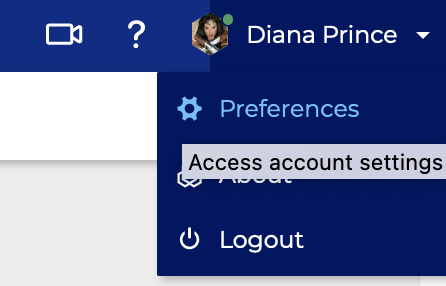
Some modifications are automatically taken into account and saved on the fly, with an information banner appearing at the bottom of the page:

When user action is required, save and cancel buttons appear at the bottom of the page:

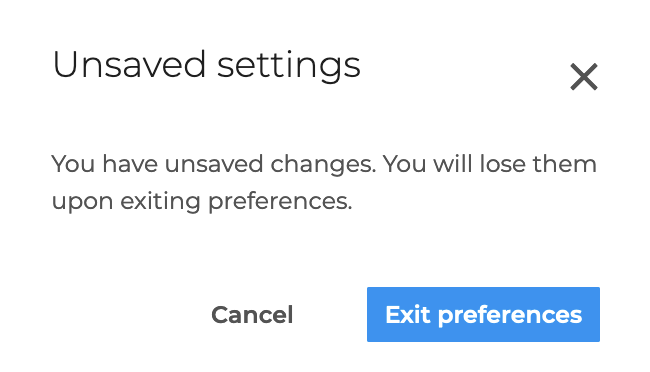
If the user clicks on the close cross to quit preference management, confirmation is requested if any changes have not been saved :
Setting general preferences
Setting localization preferences
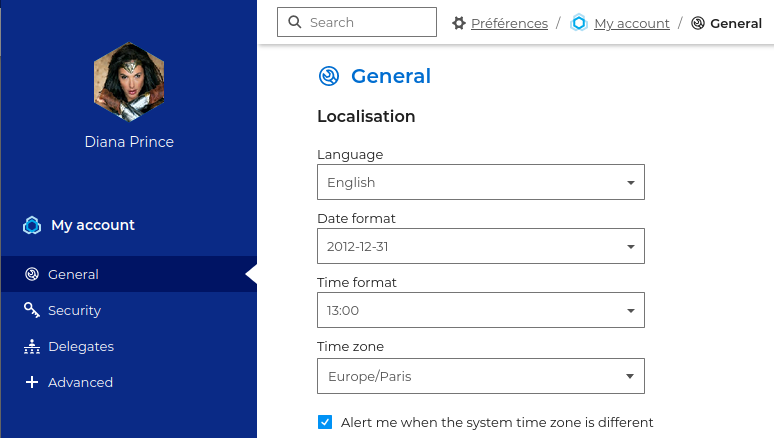
The Localization section lets you adjust the app's general localization and display settings:
-
The interface language
-
The date display format:
dd/mm/yyyyoryyyy/mm/ddormm/dd/yyyy -
The time display format: in 24-hour
13:00or in Anglo-Saxon format1:00 pm -
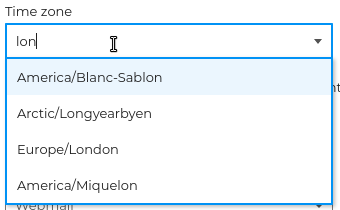
The time zone: select and clear the text to see all available time zones, or type the first letters of the country or city to search for a time zone:
Consistency with the environment
When the chosen time zone is different from that of the system, a link allows you to easily bring it into line:
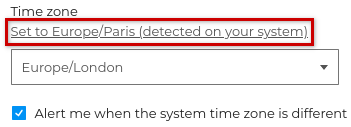
The option " Alert me when the system's time zone is different " allows you to be notified when the chosen time zone differs from that of the workstation:

💡 Unchecking this option allows you to use a different time zone without being alerted every time you reconnect.
BlueMind is currently translated and being translated into several languages. The available languages and their evolution can be consulted on the site dedicated to the application's translation: https://forge.blue-mind.net/translate/
Setting the default startup app
Also in general preferences, Default Application allows to choose the application that will open when connecting to BlueMind: Mail or Calendar.

Choosing theme
The theme allows you to display the mailbox in light mode or in dark mode. By checking the System theme option, the display adapts to the mode defined in the computer settings.
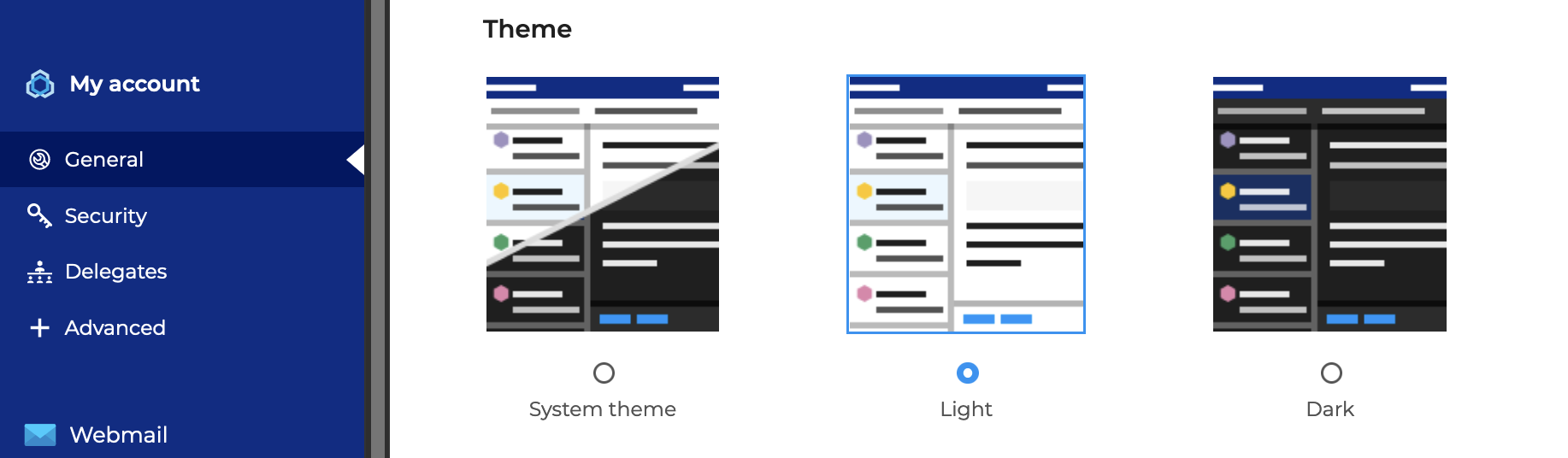
The dark theme is currently only available for the Mail application. For further information, see, Customizing Mail.
Managing categories
Categories let you add one or more keywords (or tags) to emails, contacts and calendar events, so you can categorize and find them quickly.
Domain tags, created by the administrator, appear automatically :
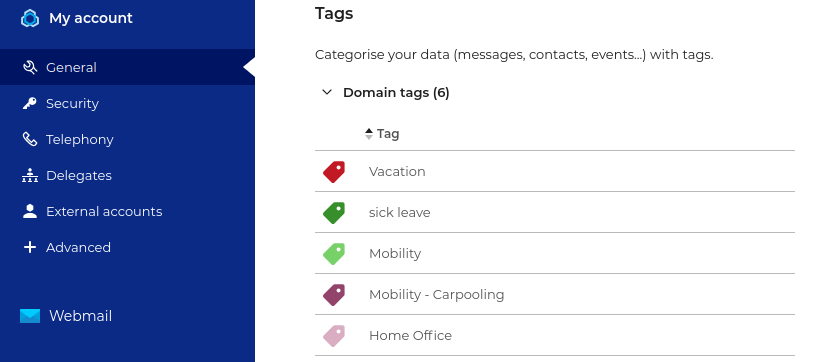
Domain categories are not editable and cannot be added to emails, only to contacts or events.
Personal categories appear under "My tags" :
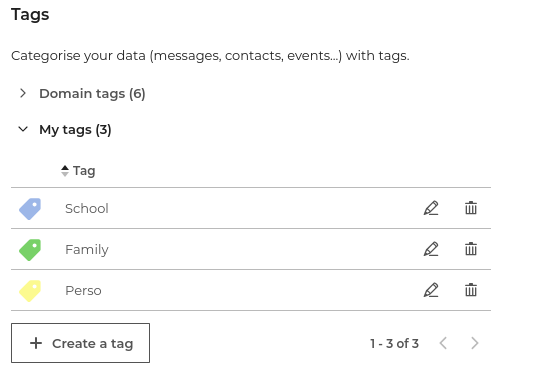
To sort or reverse the sort order, click on the column header  .
.
To add a personal category, go to "+ Create a category" then
- enter a name
- choose a color (by default, an available color is suggested)
- click Create
Go to  to modify and to
  to remove a category.
Renaming a category is equivalent to deleting it and creating a new one: the category is not modified on emails. Like categories removed from the user's preferences, renamed categories continue to be visible on emails where they have been used, but in grayed-out form.
Categories are associated with the account. Therefore :
-
Only the account owner can change categories from the preferences. Delegates or users with write access to a shared mailbox can create or Adding tags messages from the mailbox, but cannot modify the text or color, or delete them.
-
The delegate only accesses their own categories, i.e., domain categories and their personal categories. A delegate or user with write rights on address books or calendars cannot therefore assign the delegator's personal categories to the contacts or events.
For further information, see:
Managing security settings
The "Security" section lets you manage your password and generate API keys:
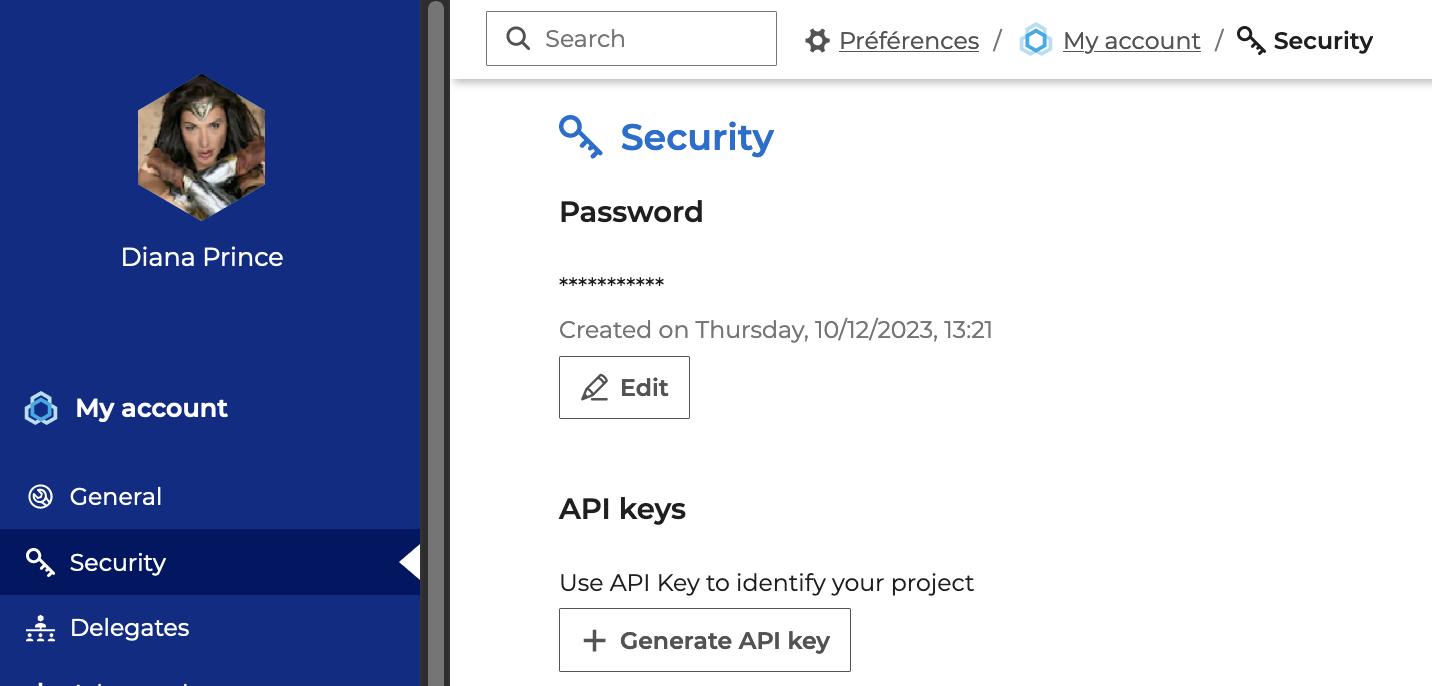
Changing your password
To change password :
- click on Edit to open the pop-up window:
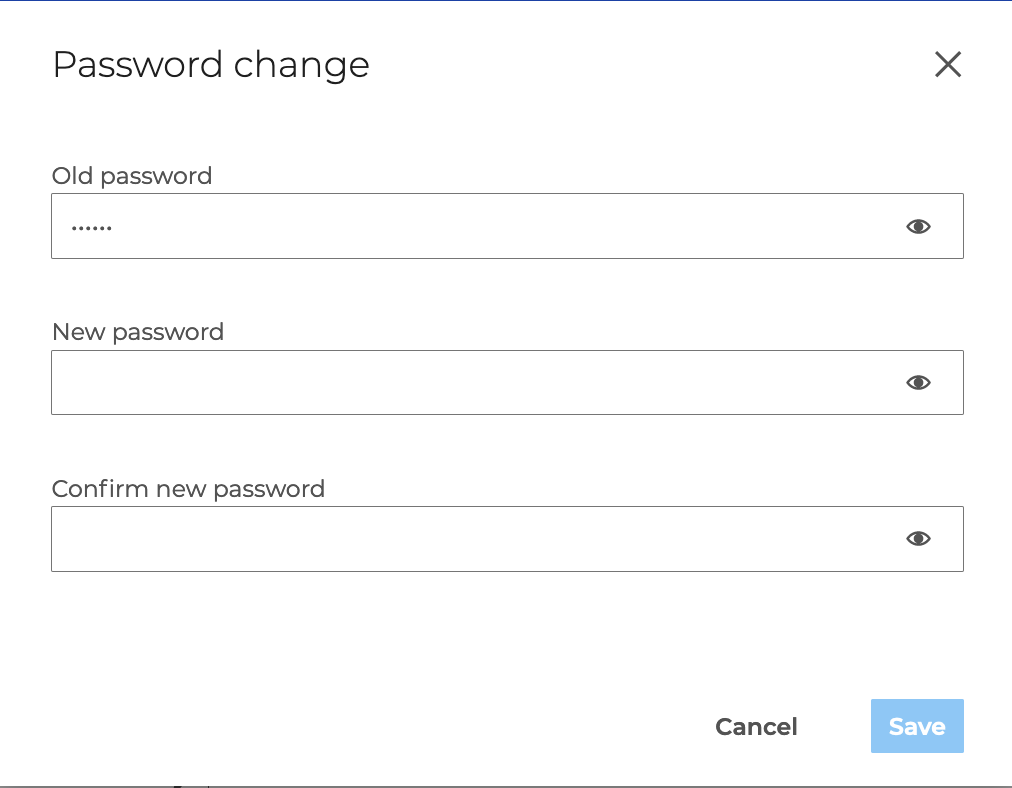
- enter the new password in the "New password" and "Confirm new password" fields
- click Save
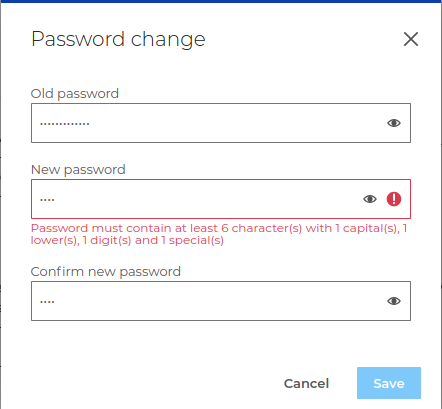
A password policy can be defined by administrators, the interface then alerts you when the new password does not comply with the requirements:
Managing API keys
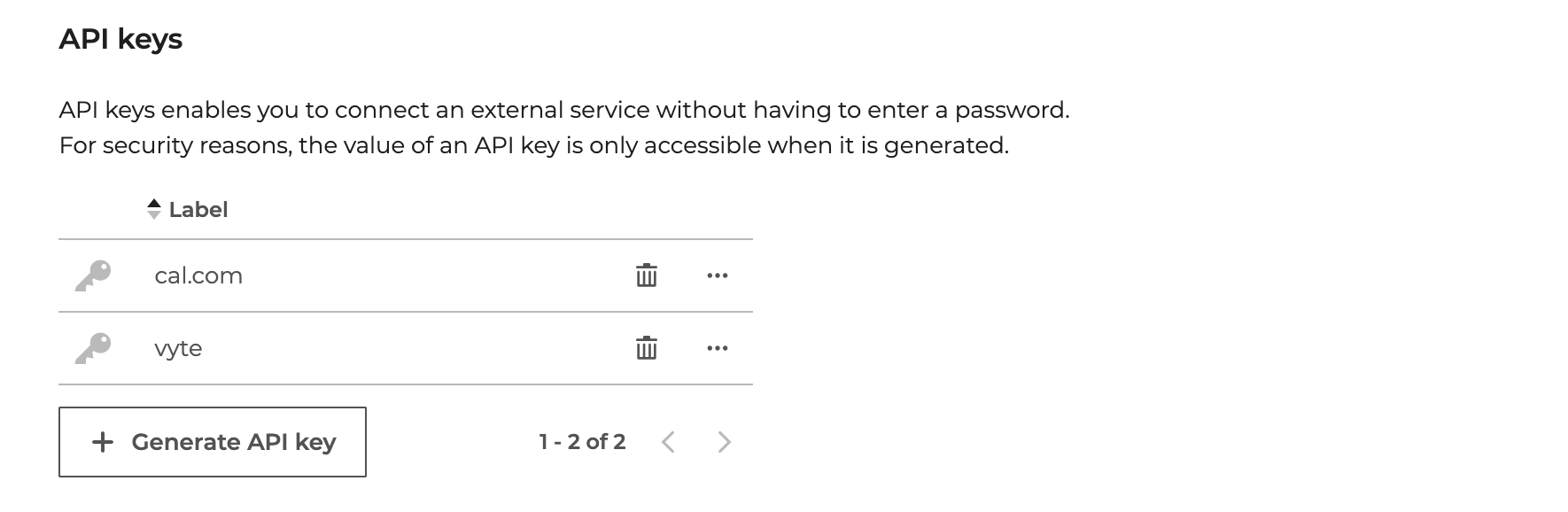
API keys can be used to connect to a user account without using the account login password. In particular, they enable you to connect an external service without having to provide it with the user password, and to revoke access at any time by deleting the key.
Generating an API key
To create a key :
-
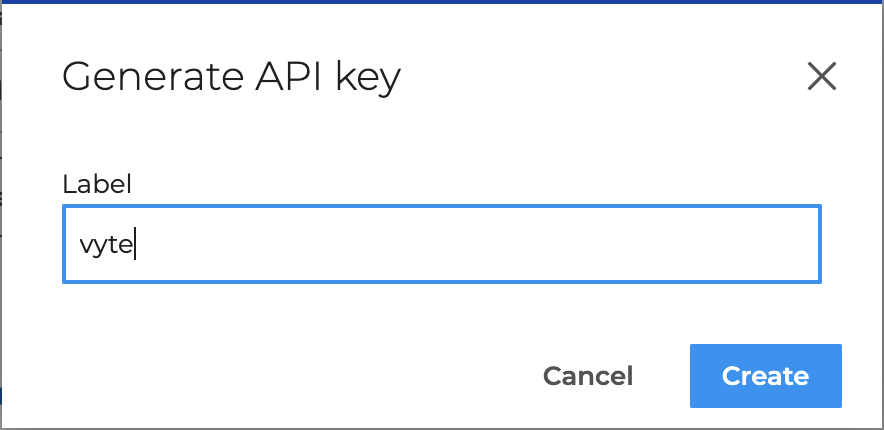
click on the + Generate API key button to open the pop-up window:
-
enter a name to identify the use of the key (e.g. the name of the service or site for which it will be used), then click on Generate.
-
copy the value of the API key to add it to the external service and retain it if necessary, then click on End.
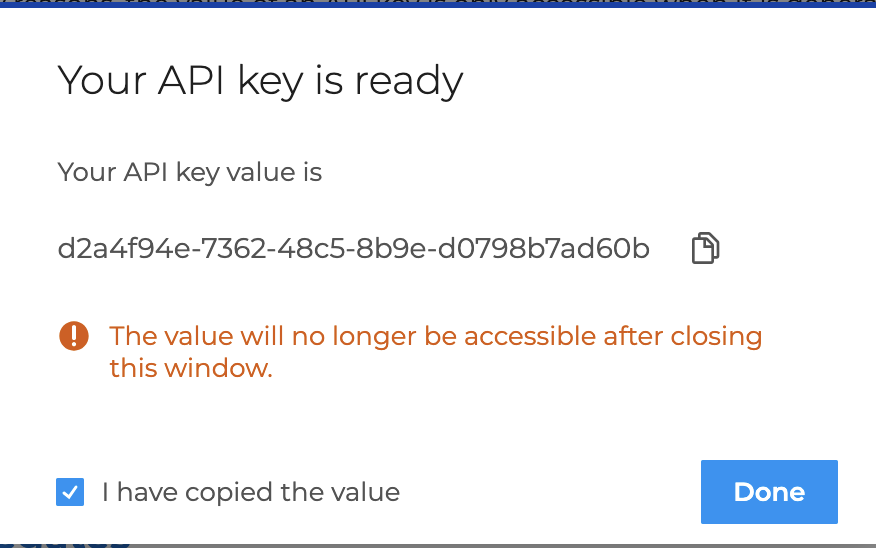
⚠️ For added security, the API key value is only visible when it is created, and cannot be retrieved afterwards.
The key is immediately created and added to the list of user keys. Each user can create as many keys as they wish.
Overwrite an API key
If a PLC key loses its value, it can be regenerated.
To do this:
- click on Overwrite with new value in the key menu
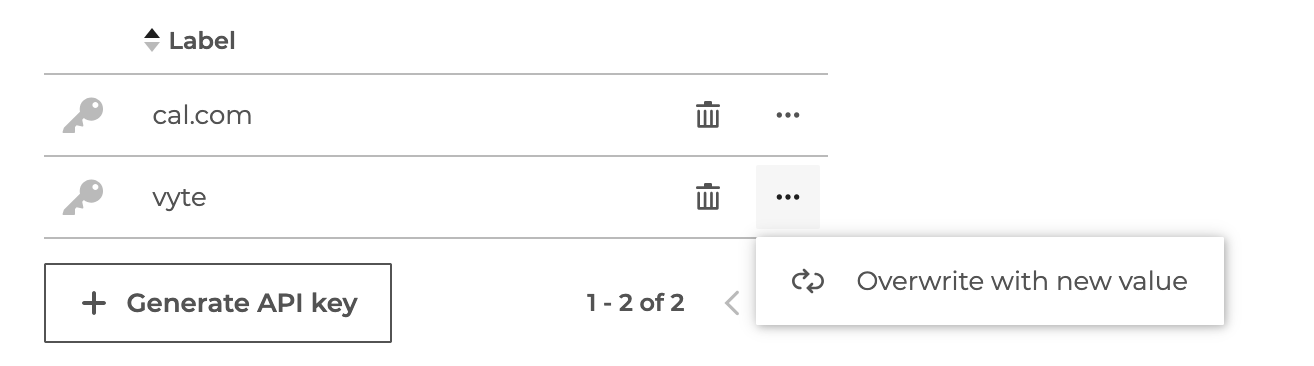
- validate by clicking on Overwrite in the pop-up window
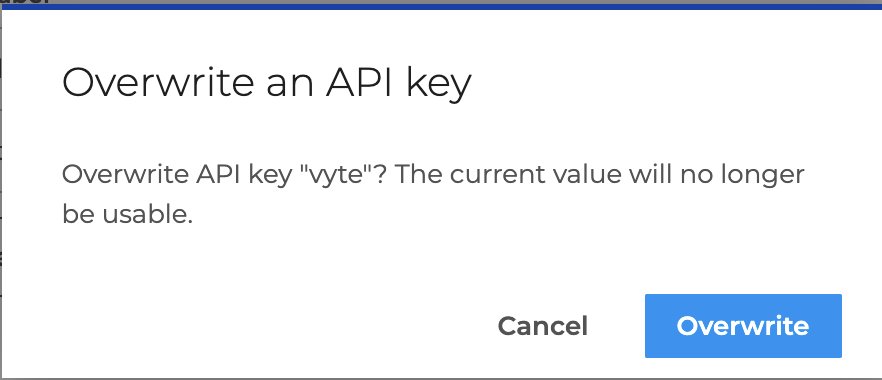
- copy the new API key value
Delete an API key
When an API key is no longer in use, it is advisable to delete it for greater security.
To do this:
- click on the icon of the desired API key
- validate by clicking on Delete in the pop-up window
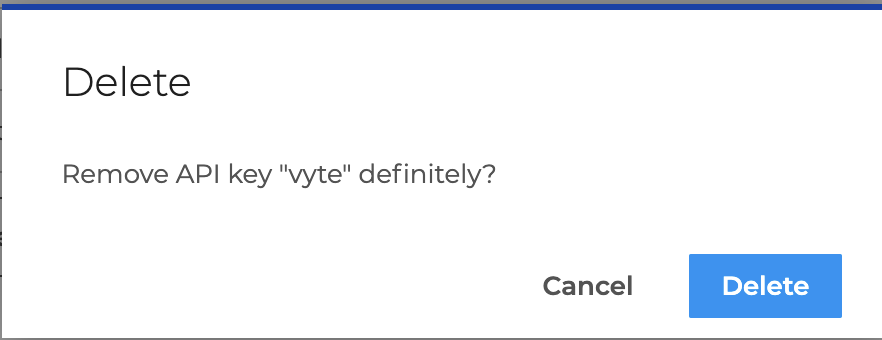
The key is immediately removed from the list.
Securing connection with OTP
OTP stands for "One Time Password". This is a randomly generated 6-digit number that strengthens authentication and complements the user's password. This number is valid only once for 30 seconds, after which a new number is generated.
See below:
Authentication security must first be activated by an administrator. For further information, see Multi-factor authentication via OTP.
Initial OTP configuration
When OTP security is enabled, BlueMind automatically proposes a key for the next connection:
- Visit BlueMind with a browser (computer or mobile)
- Once username and password have been entered in the usual form, BlueMind presents the configuration page:
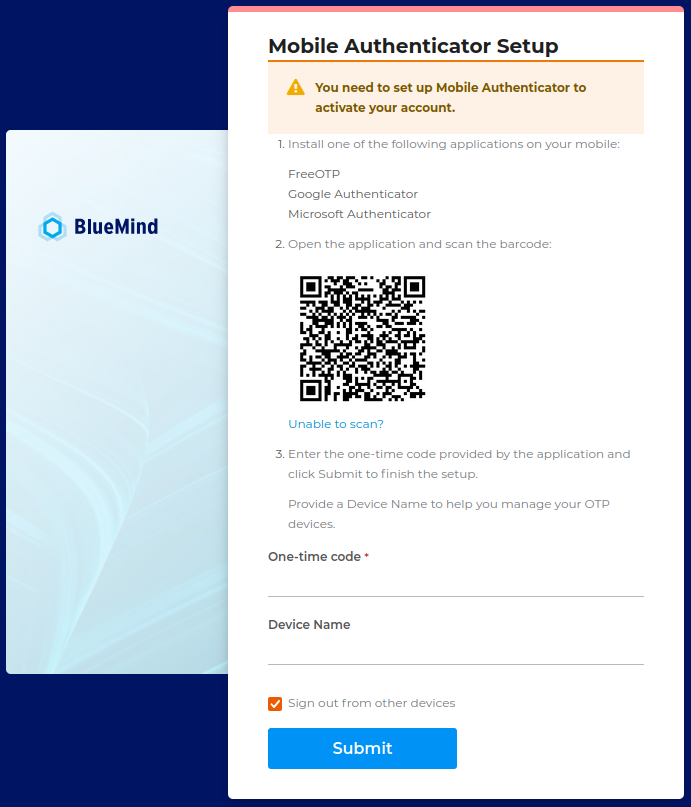
- The 1st point presents the compatible secure applications, which the user is free to choose from.
- Use the application to scan the QR Code displayed on the screen.
💡 If the proposed QR Code cannot be scanned (no device available, use on the mobile itself, user's choice, etc.), click on "Unable to scan? :
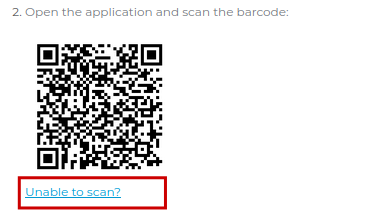
An identification key is then proposed, which must be copied/pasted or recopied into the chosen application:
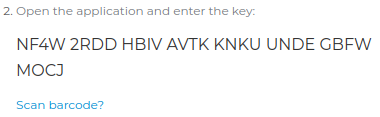
💡 To return to the QR Code, click "Scan bar code? "
The screen also adds a point giving the security rules to be respected or set in the application if necessary, namely :- Type : Time-based
- Algorithm: SHA1
- Numbers: 6
- Interval: 30
- In return, the application supplies a single-use code; enter this code in the appropriate field:
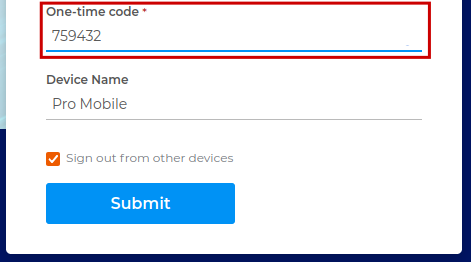
- Name the device then click on "Submit" to validate the connection.
💡 Device name
The "Device name" field is free, and is used to identify the device or application used in the event that the user connects to BlueMind by different means (mobile application on the move and key manager built-in to the workstation browser, for example) and therefore needs to manage several keys.
Managing OTP keys
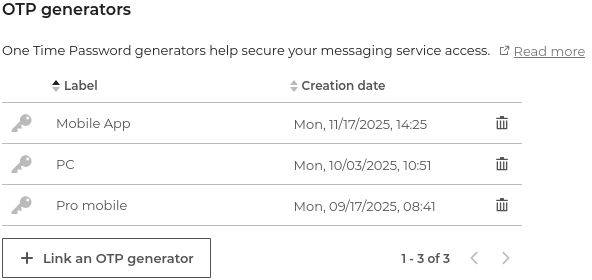
To view, delete or create new keys, go to the preferences section My Account > Security > OTP Generators :
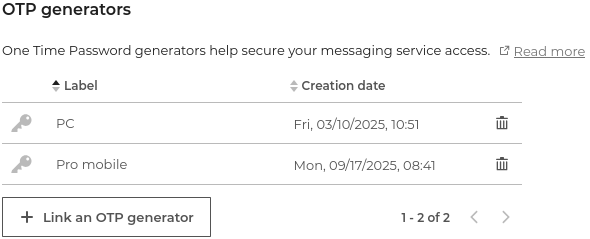
To revoke a key, click on the corresponding  icon.
icon.
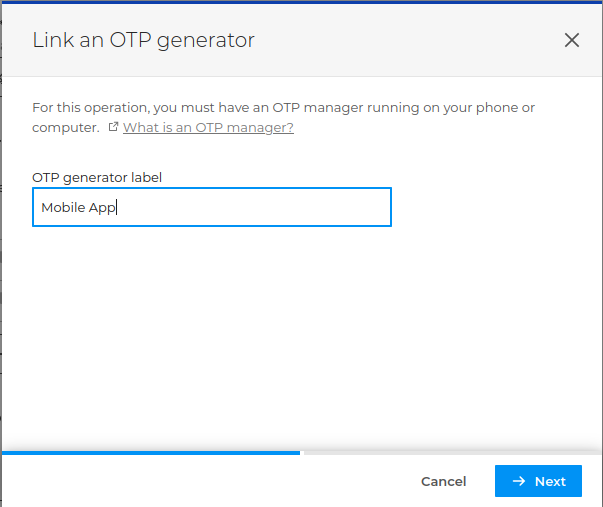
To create a new key, click on " Associate an OTP generator " then :
- Name the key and click on " Next " :
- Use the desired method to create the key, in the same way as in initial configuration:
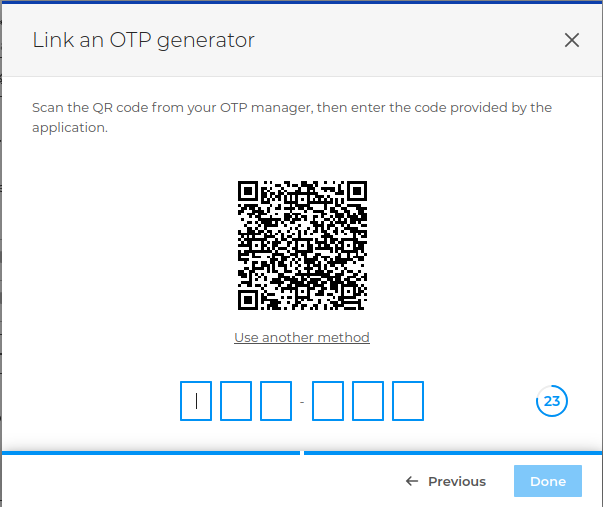
- Enter the code given by the handler used:
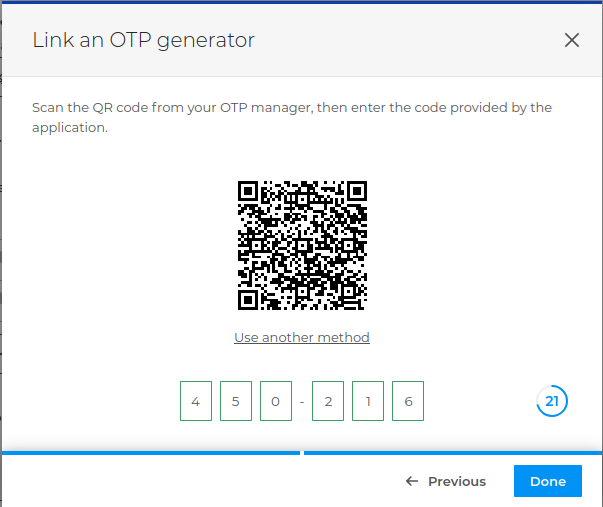
- Click on " Done ", the key is added to the list:
Login with OTP
After at least one key has been created (see above):
- Visit BlueMind with a browser (computer or mobile)
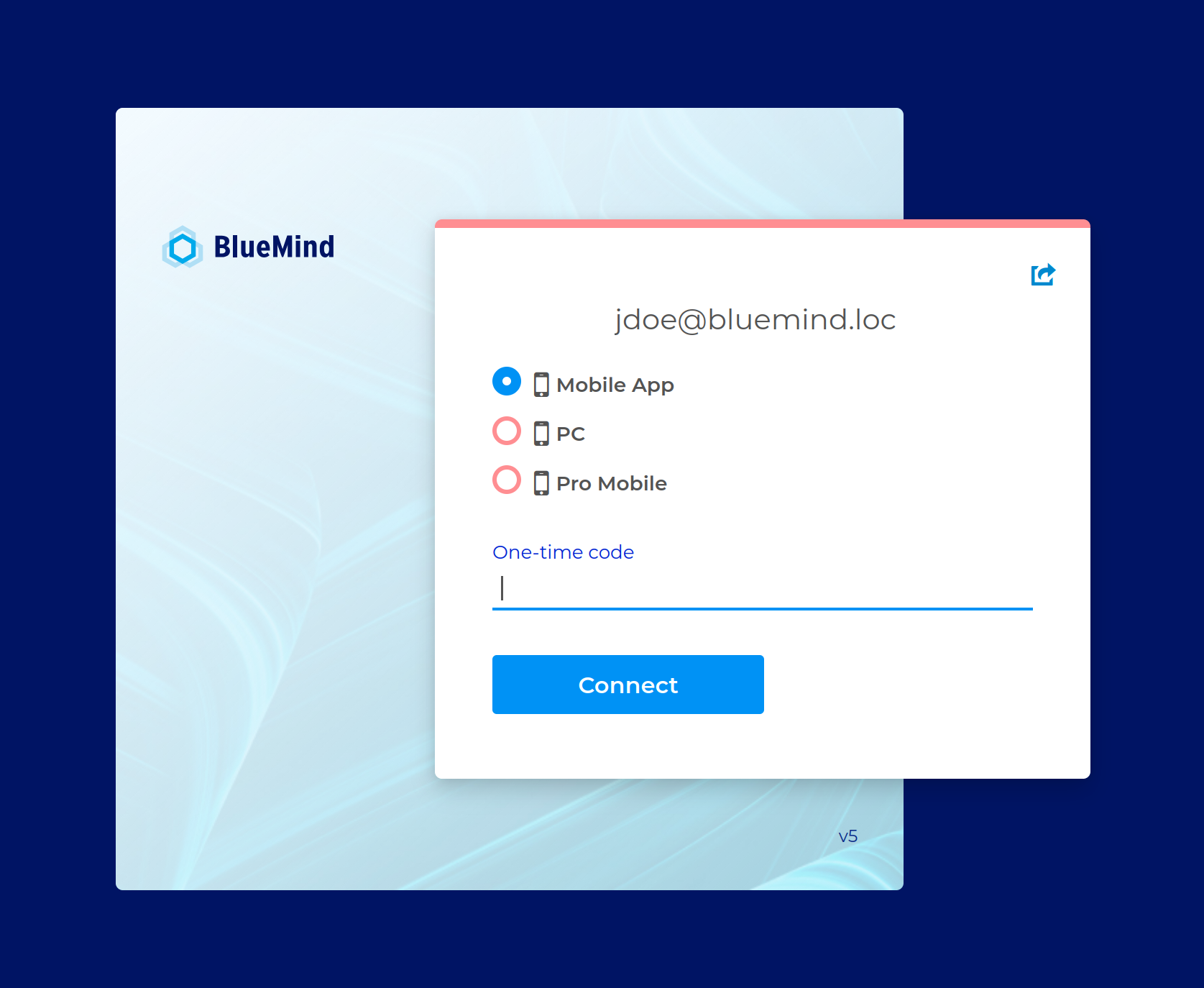
- Once you've entered username and password in the usual form, BlueMind asks you to enter a one-time code:
To log in:
- Select the appropriate key (available only when multiple keys are configured).
- **Open the corresponding application
- Generate a code NB: some applications offer the code directly and renew it automatically every 30 seconds.
- Enter code
- Click "Connect"
Managing delegations
The Delegations section allows to appoint delegates and define the level of their rights.
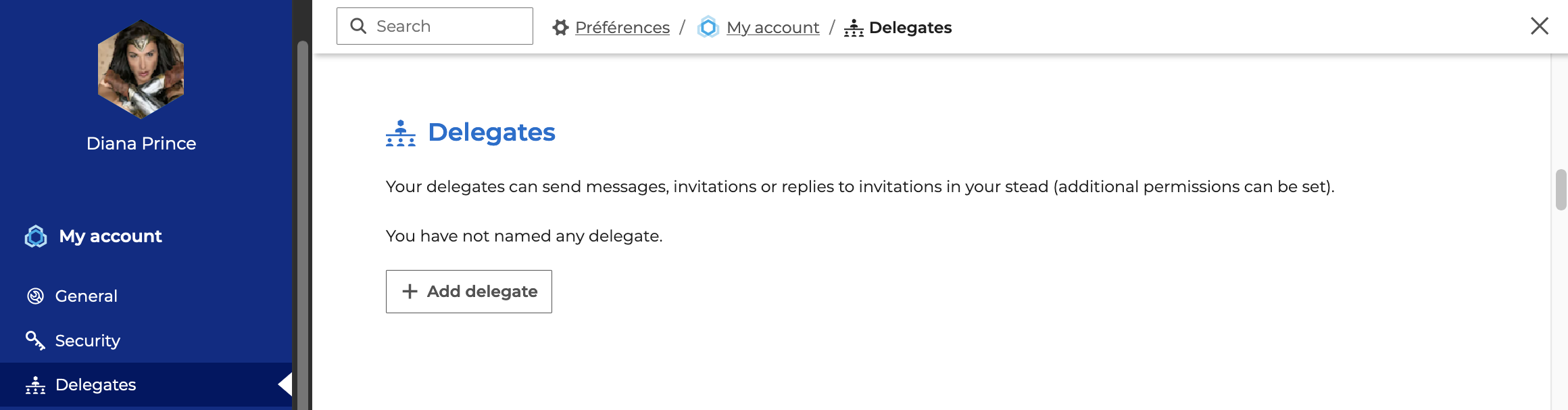
A delegate is a user or group of users in the domain who has the right to act on behalf of the delegating user. Depending on the options chosen, the delegate :
Note that delegations only concern the default mailbox and calendar (My mailbox, My calendar). It is not possible to create delegations for user-created e-mail addresses or secondary calendars.
To make it easier to manage the sharing of default applications (My Mailbox, My Calendar, My Contacts, My Tasks), users can also modify access levels, for each delegate, from this section.
Creating a delegation
To add a delegate :
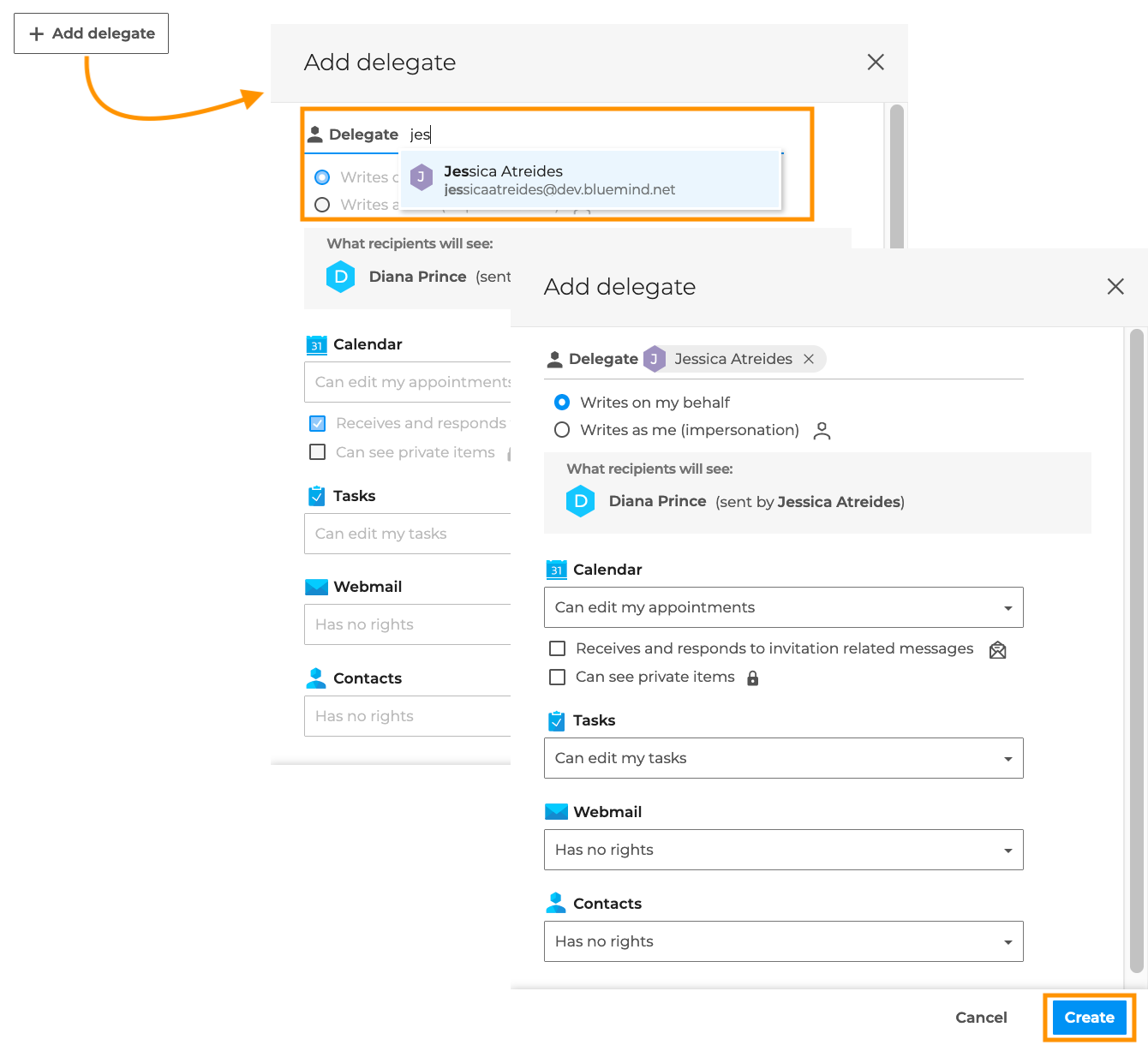
- Click on "+ Create a delegation" to open the pop-up window
- Add a user or group in the "Delegate" field: type the first few letters and choose from the autocomplete list.
- Set up delegation by selecting the desired options and levels of application access rights.
- Click on "Create"
Setting up a delegation
1. Define the level of delegation
A delegation allows a delegated user to send emails using the delegating user's email address. The first parameter to set is the desired level of customization. Depending on the option selected, the recipient may or may not see that the email has been sent by a delegate.
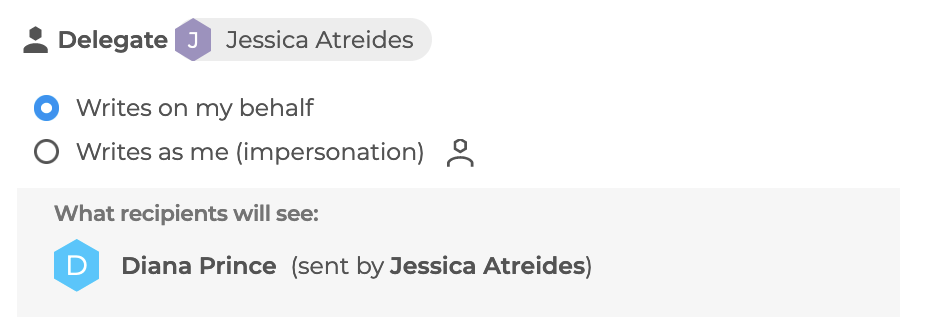
⇒ Minimum option: The delegate can write on my behalf
The "Written by me" option is checked automatically, is the minimum right to create a delegation**.
With this option, when the delegate sends a message with the delegating user's e-mail address, the recipient sees that the message has been sent by the delegate:
See the documentation Writing on behalf of another user for more details on using this option.
⇒ Maximum option: The delegate can write as me
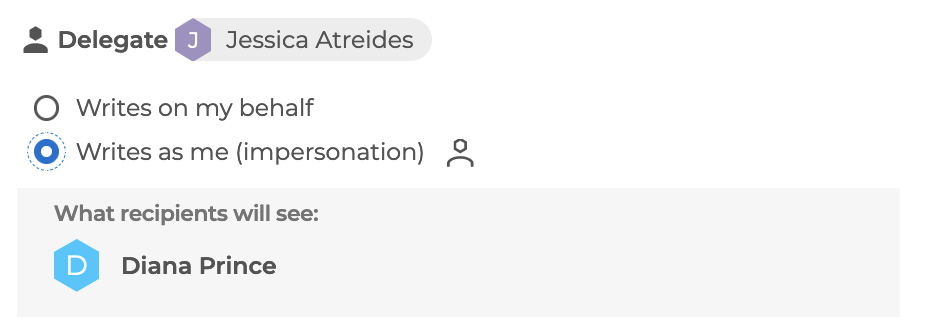
The "Write as me" option completely impersonates the sent emails.
This option allows the delegate to send messages with the delegating user's e-mail address without the recipient seeing it:
See the documentation Write as another user for more details on using this option.
No messaging sharing level is required for a delegate to write on behalf or in the name of a delegator. However, it is advisable to give him at least read rights, so that he can see and reply to messages received by the delegator.
2. Grant invitation management rights
After selecting the delegation level, it is possible to allow the delegate to manage invitations received by the delegator from their Mail app.
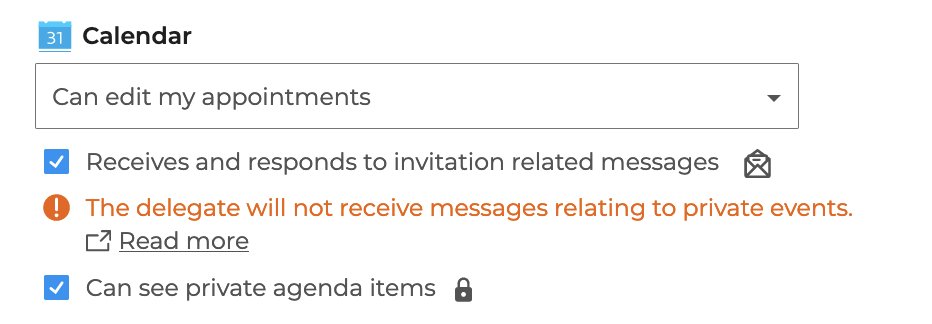
To do this, select at least the "Can edit my appointments" Agenda sharing level and check the desired option(s):
⇒ Minimum option: The delegate receives and responds to my invitations
For the delegate to manage invitations from their messaging, tick the option "Receives invitations-related messages and replies to them".
In addition to the default calendar write rights - allowing events to be managed from the Calendar - the delegate receives all notifications related to the delegator's public events on his/her mailbox and can respond, "from" or "as" the delegator - depending on the delegation option chosen.
This option does not require the delegate to have read rights to the delegator's mailbox.
See the documentation Delegating invitation management for more details on how to use this option.
⇒ Maximum option: The delegate can see my private events
An additional right can be granted to the delegate to see and manage private events from the Calendar. To do this, also tick the option "Can view private events in the Calendar".
When this option is ticked, the delegate can see the details of the private event and can respond to the invitation in the Calendar.
Whatever the chosen delegation level, a delegate never receives notifications of private events in their mailbox. A delegate can only manage private events from Calendar.
⇒ Additional parameter: the delegator chooses whether or not to manage his invitations
As soon as at least one delegate is created with the "Receives and responds to invitation messages" option, an additional setting is displayed under the delegation summary table, allowing the delegate to choose whether or not he/she also wishes to manage his/her invitations:

- I do not receive messages: only the delegate receives the notification and manages the invitation, the delegator does not receive either the invitation or the responses sent by the delegate
- I receive a copy: both the delegate and the delegator receive the invitation, but only the delegate can manage the invitation; the delegator receives a read-only copy of the invitation and can see the delegate's response in the date icon:
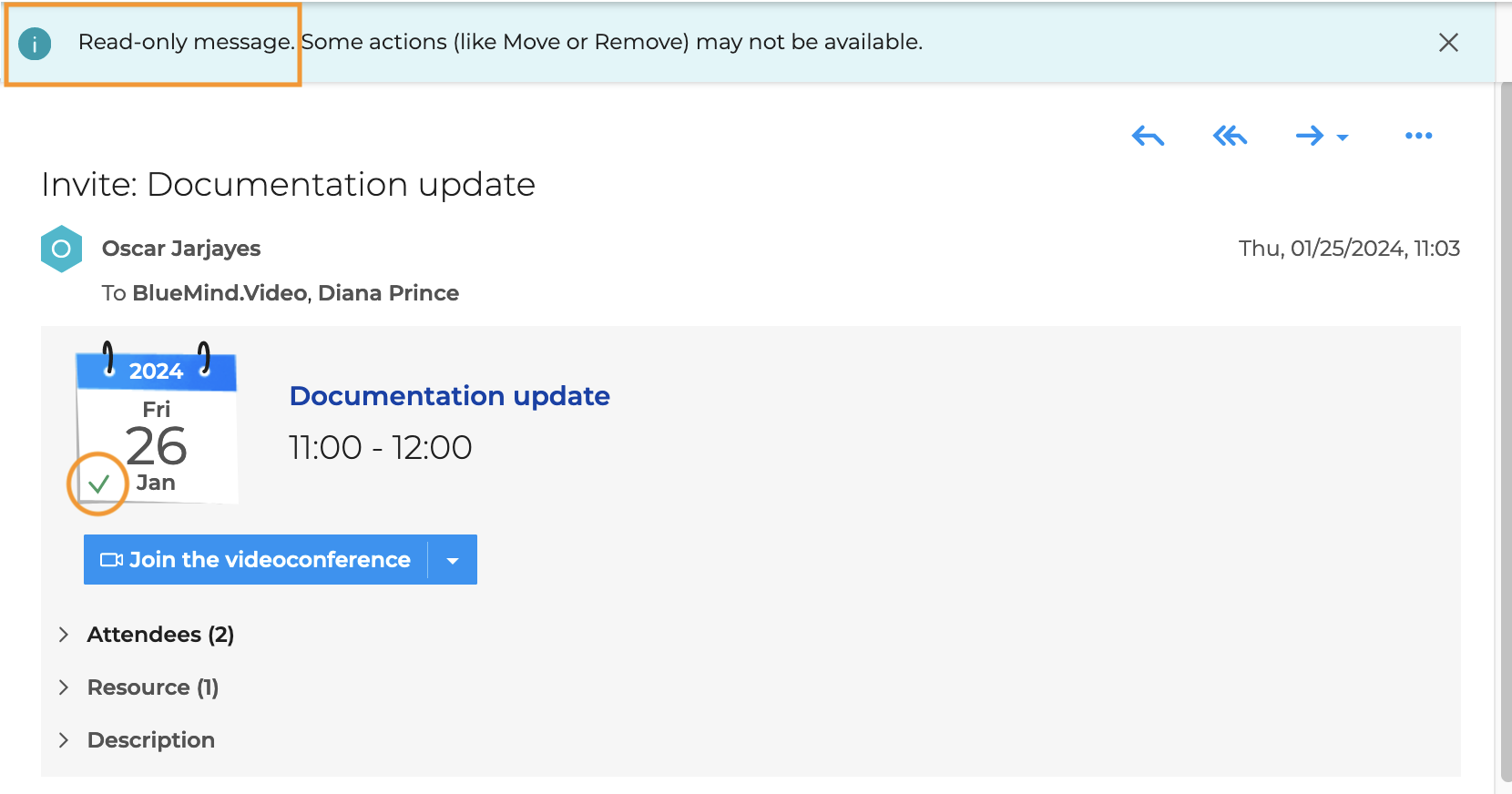
- I also receive messages: the delegate and the delegator receive the invitation and can manage the invitation - this setting is selected by default
Refer to the documentation Managing invitations for more details on managing invitations from Messaging.
3. Manage access to my default applications
The delegation creation window also allows you to view and set default application sharing levels (My mailbox, My contacts, My calendar, My tasks) assigned to the delegate.
When a delegate is selected, the sharing rights previously assigned in the share management for each application are automatically displayed.
If no rights have been defined, the default rights are :
- Calendar: "Can change my appointments
- Tasks: "Can modify my tasks".
- Mail: "Has no rights"
- Contacts : "Has no rights
When a right is modified here, the modification is immediately taken into account in the application's share management (refresh the page if necessary).
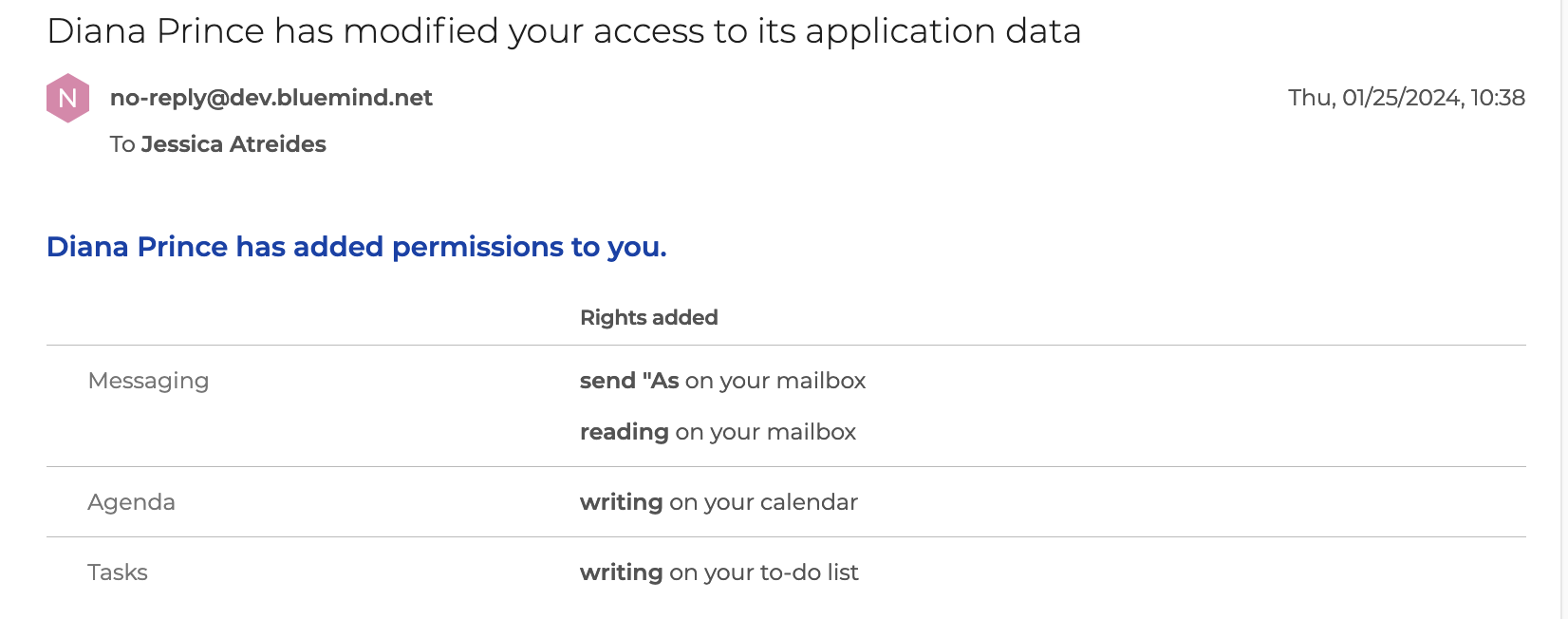
Once the delegation is created, the delegate receives an email notification summarizing the rights granted to them :
Managing delegations
Once delegations have been created, a table summarizes all the delegations and rights granted to each delegate :
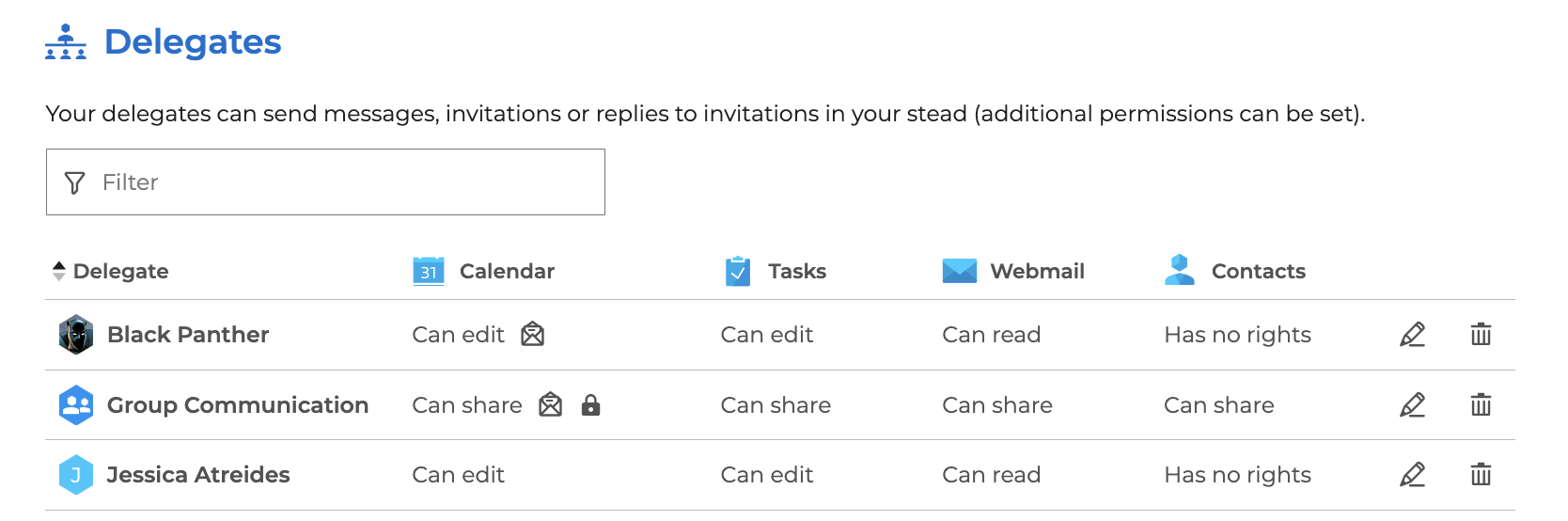
- The
 icon indicates that the delegate Write as me
 - The
 icon indicates that the delegate Receives and responds to my invitations
 - The
 icon indicates that the delegate Can see my private events
Click on  to modify a delegation and to delete it.
Managing external accounts
BlueMind connects with a number of services to make it easier for users to exchange and use their data (attach files from a Nextcloud, Interstis or Alfresco drive, launch calls with Xivo or Wazo, connect to Teams meetings, etc.).
Create an external account
To configure the connection to an external account, go to Preferences > My account > External accounts:
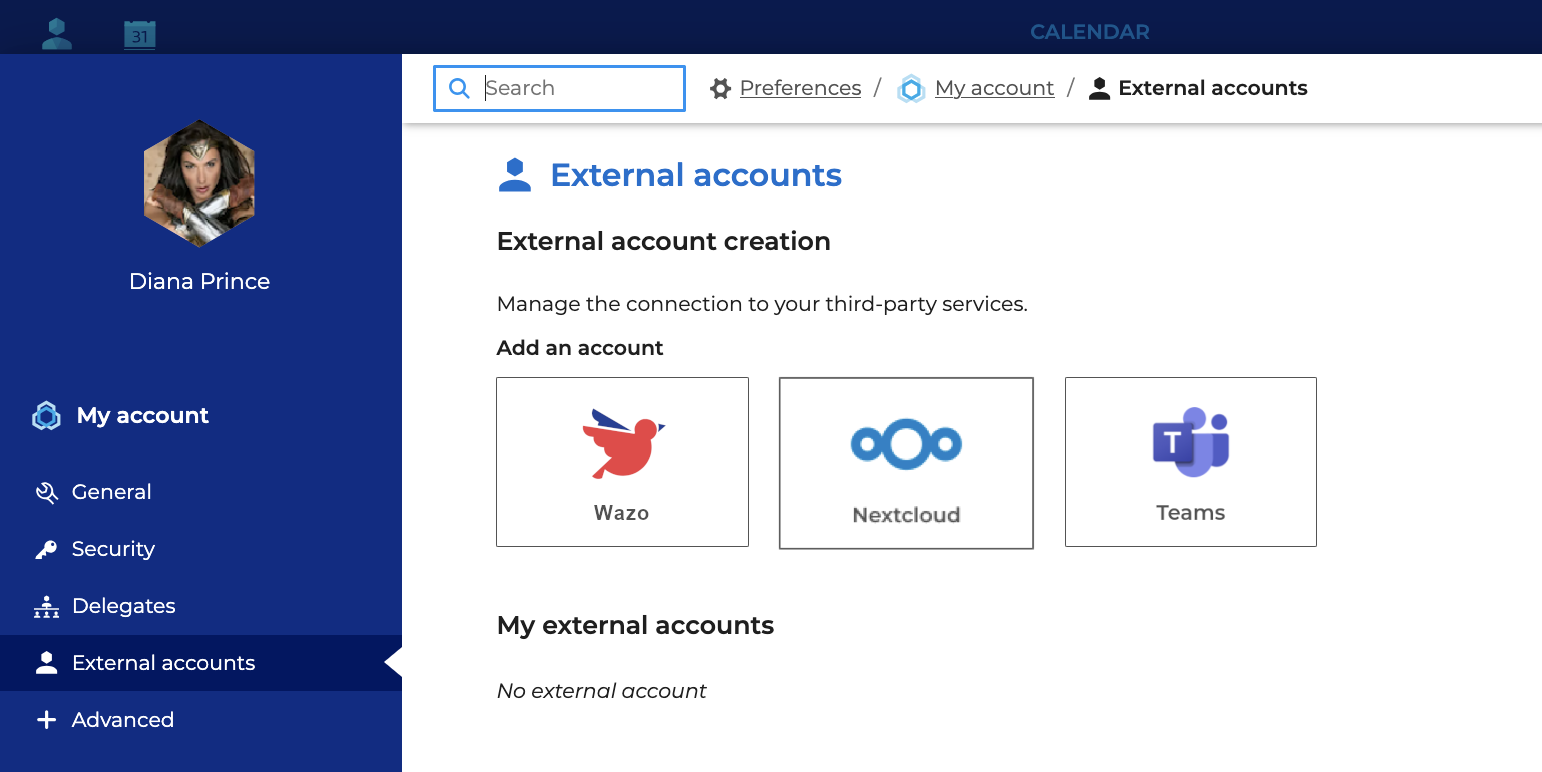
If a service does not appear, contact an administrator: only installed and activated services are visible.
Click the desired service and Fill in the required information :
- Alfresco
- Interstis
- Nextcloud
- Teams
- Wazo
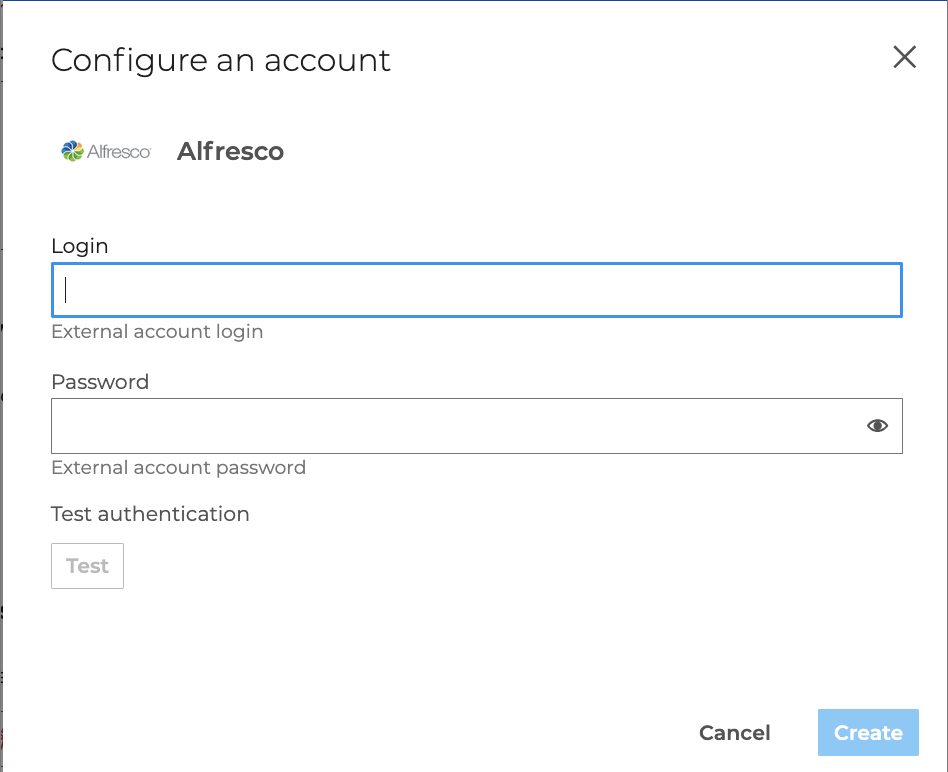
- Enter your username and password,
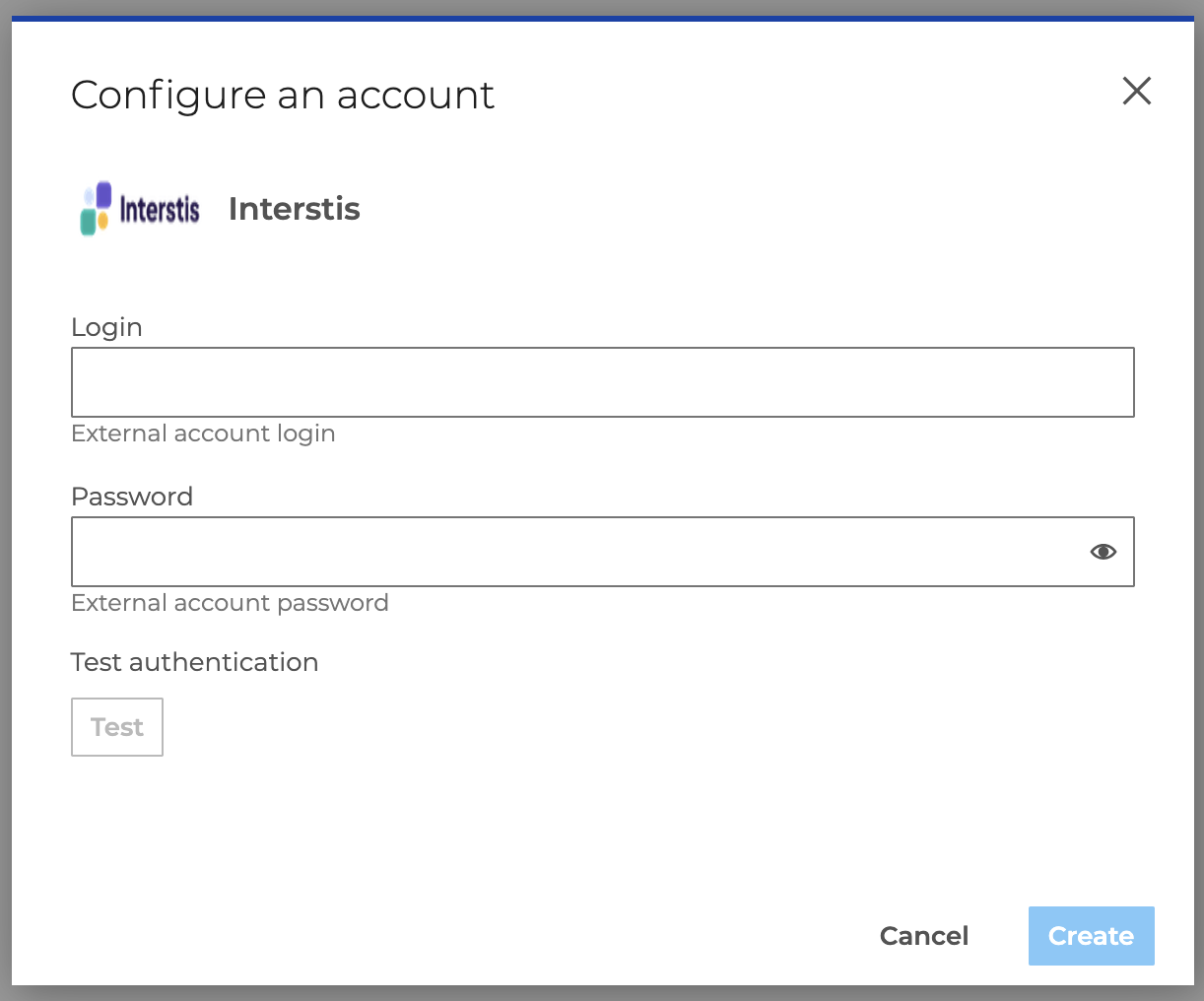
- Enter your username and password,
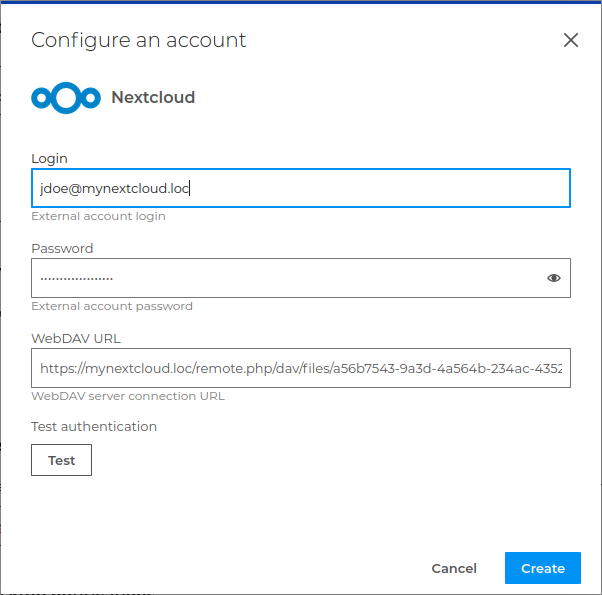
-
Enter the username and password,
LDAP SynchronizationWhen Nextcloud is connected to an LDAP directory, the WebDAV URL is no longer formed using the user’s username but with the account’s UUID; it takes the form
https://<serveur_nextcloud>/remote.php/dav/files/<UUID>.
It is therefore necessary to specify the WebDAV URL, which can be found in the Files settings of the user’s Nextcloud space: in Nextcloud, go to the Files app and navigate to Files Settings > WebDAV: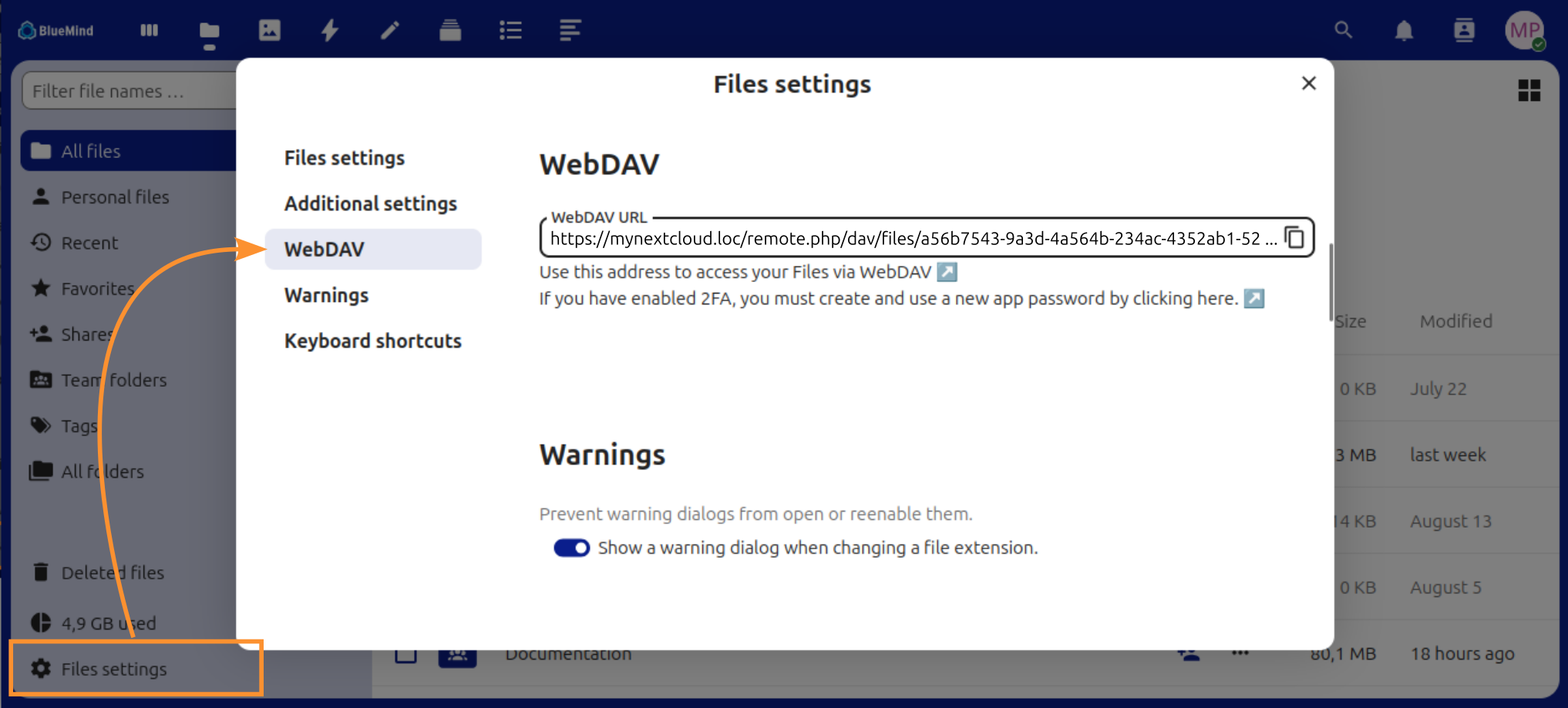
💡 If you are unsure whether this synchronization is enabled, you can configure the URL without risking any disruption to normal operation.
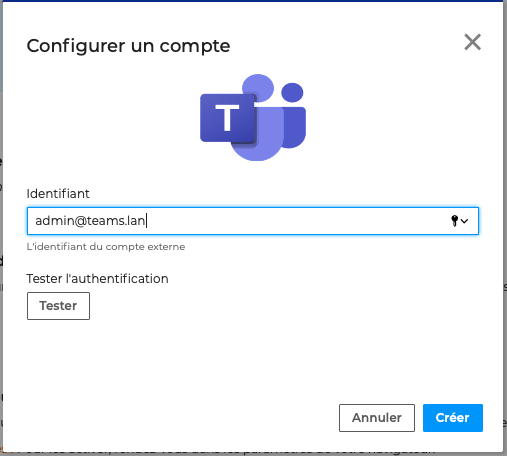
- Enter your username (email address used in Teams),
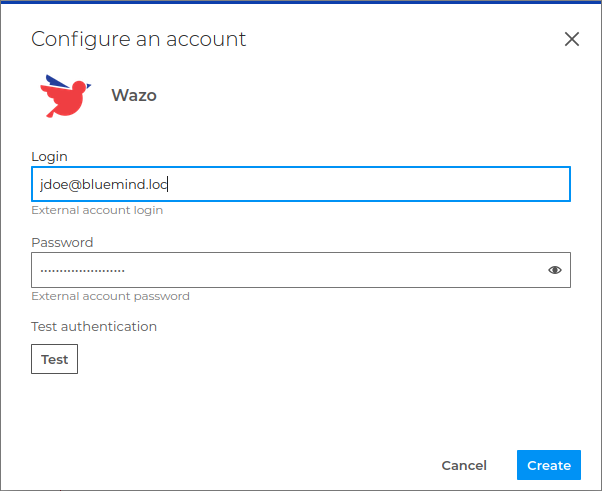
- Enter your username and password,
- Click Test to validate the parameters,
- If the test is successful, click Create.
Modify/delete an external account
Existing accounts are listed under the logos of the available services:
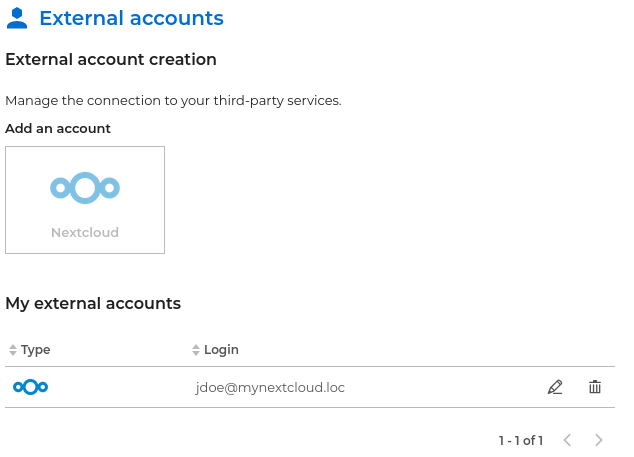
- Click to modify an account's configuration.
- Click to remove the connection to an external account.
Managing advanced settings
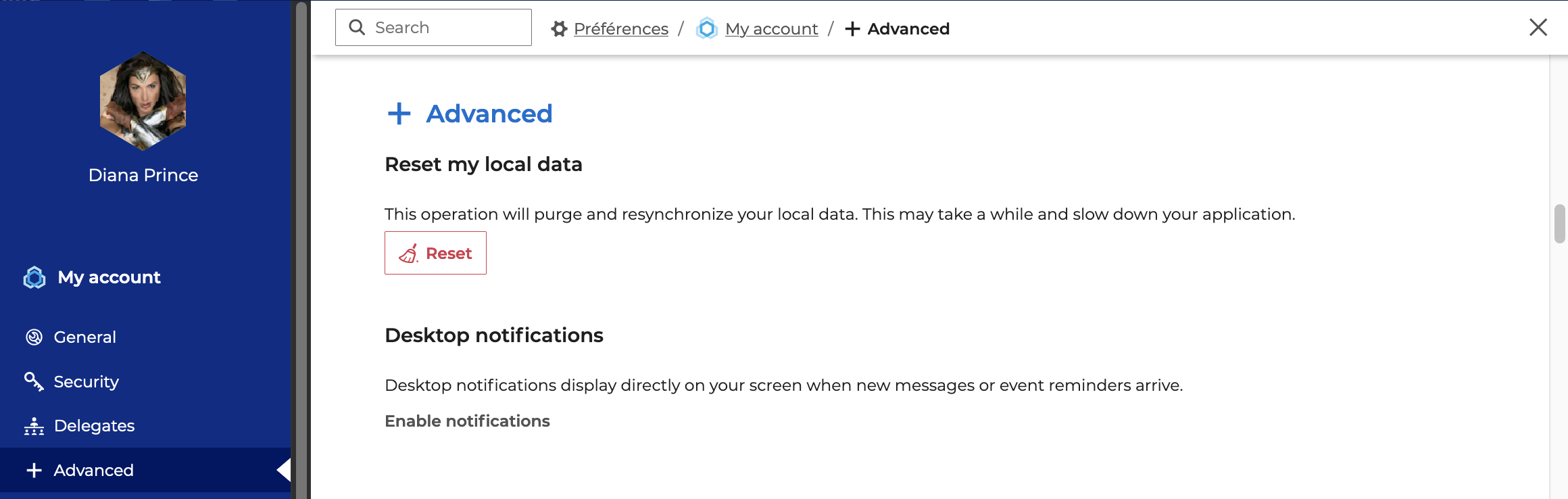
The "+ Advanced" section of the user account preferences gives access to the application's reset local data and enable notifications:
Resetting local data
When using the BlueMind solution, the browser saves session-related data, such as user preferences, contacts used, etc. Thanks to these records, the server automatically recovers regularly used data, which allows BlueMind to provide an optimal experience of its applications.
Occasionally, however, there may be inconsistencies in the local data, which can lead to display problems.
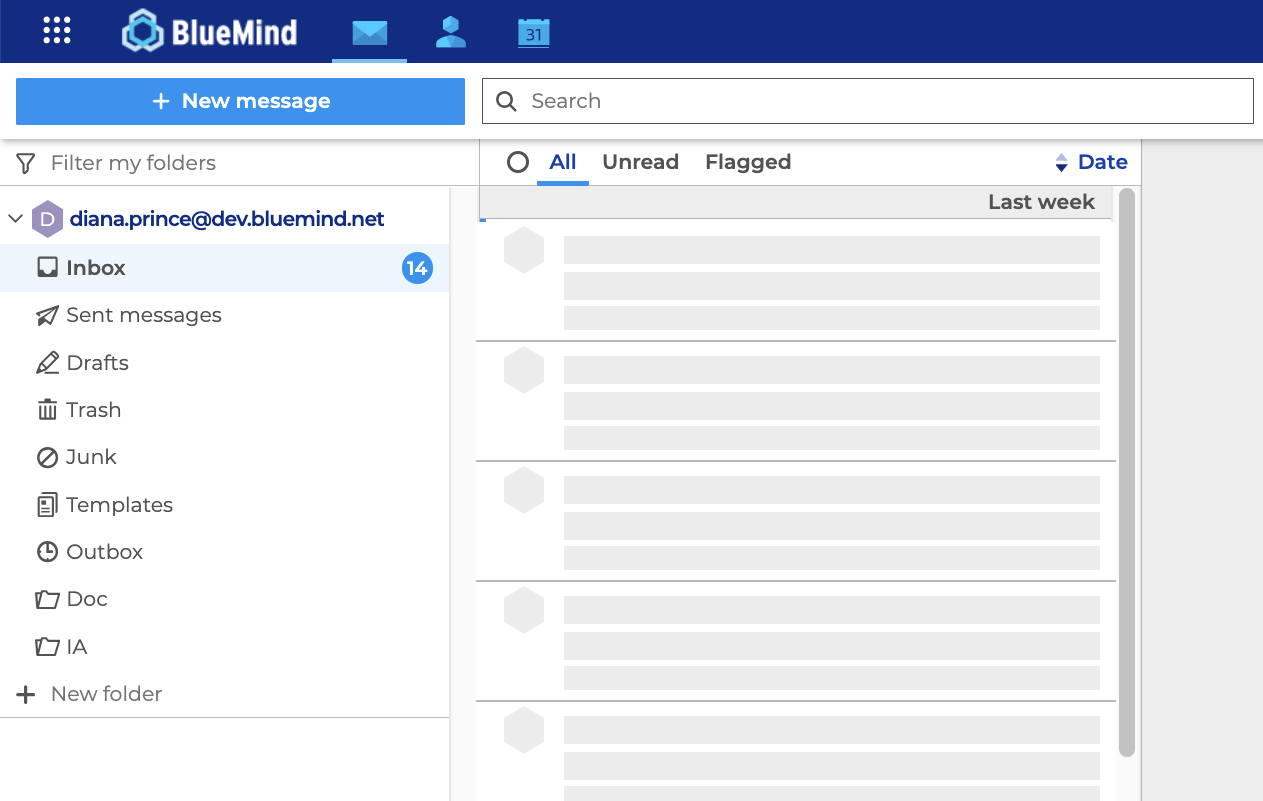
In this case, we recommend that you contact the administrator. If necessary, local data can be purged and resynchronized by clicking on "Reset".
Enable notifications
When notifications are enabled, an alert will be displayed on your screen when you get a new message or have an event reminder. To allow the browser to send these alerts, click on "Enable notifications".
This feature is supported by all BlueMind-compatible browsers. For further information, see the page Compatibility.
Download a connector
The Downloads section allows users to download the Thunderbird connector provided by BlueMind to synchronize their software.
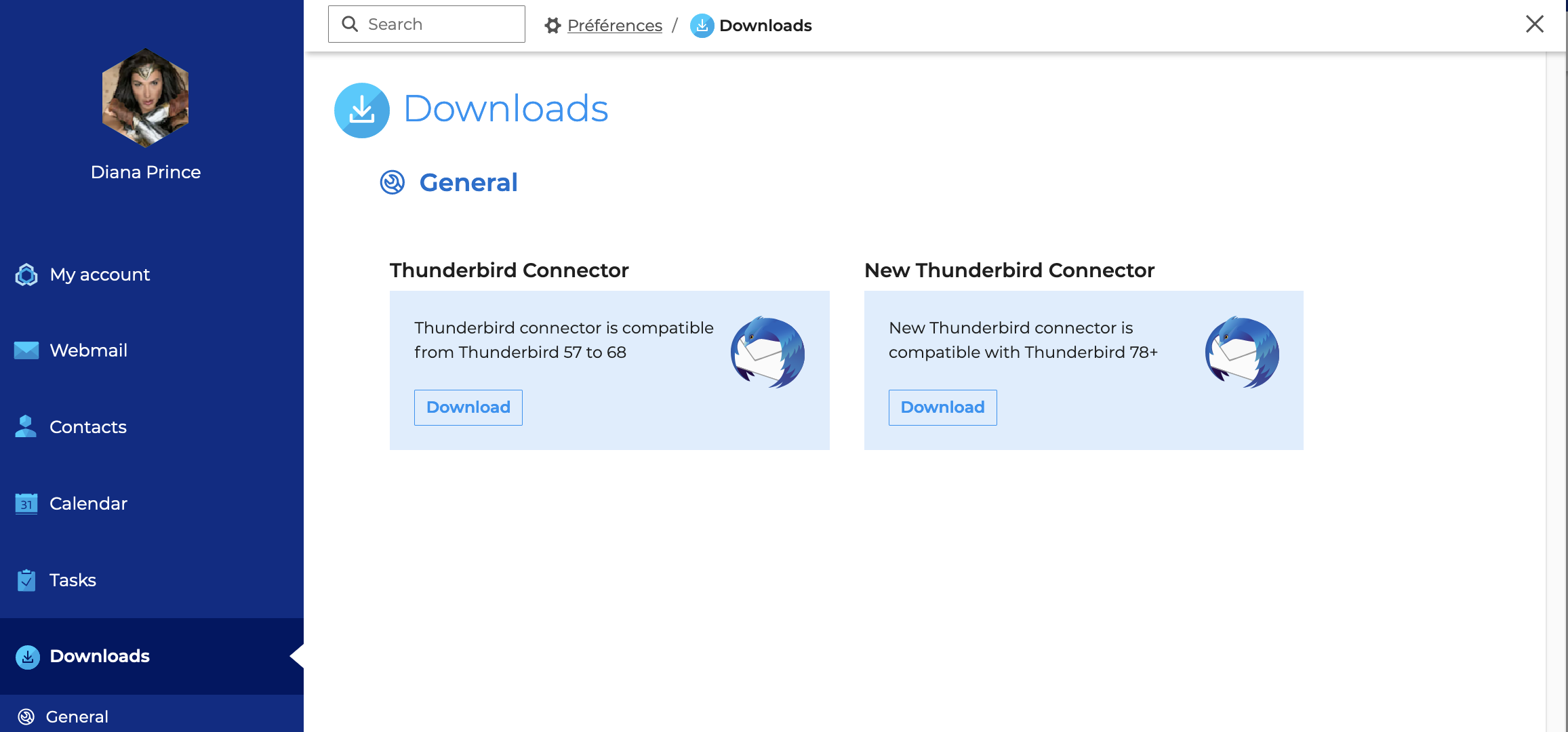
For more information, please visit the page Configuring Thunderbird.
Find out more
Watch related BlueMind videos
Manage app settings:
- Calendar:
- Mail:
- Contacts:
- Tasks :