Domain Calendars
Domain calendars are a calendar shared between all users. In addition to viewing data, the administrator can delegate editing or management rights to users or groups.
Domain calendars are treated as separate entities: they are managed through the directory entry management interface, they organize their own events, and you can populate them via ICS import, export their content in ICS format, and generate a private or public address for external sharing.
Usage
These calendars are considered to be user information calendars, for example, to publicize public holidays, company closures, commercial events (trade fairs, presentations, etc.), etc. or municipal events (council meeting, exhibition, school council, etc.), training courses, team actions, etc. or municipal events (council meeting, exhibition, school council, etc.), training courses, team actions, etc.
As a result, domain calendars can not be set as event organizers or be invited. You can only create events.
A meeting differs from a simple event in that it involves multiple participants: an organizer and one or more guests. A simple event, such as the domain calendars in this case, has only one participant: the organizer.
Use cases
Domain calendars can be considered in 2 cases:
- The information calendar, via which users can view information
⇒ The domain calendar is the ideal way to manage this type of calendar.
For example, a marketing calendar listing the trade fairs the sales team is participating in, or a town hall calendar providing details of public meetings and organised events. - The operational calendar, used to create events for users
⇒ It is preferable to use a resource calendar to enable this functionality.
For example, on an on-call duty calendar: you create a weekly event called ‘weekend on-call duty’ and each week you send an invitation to the relevant user. This allows information to be centralised and also enables users to accept, decline or indicate their availability or unavailability.
For further information For information on resource bookings, see see the page Manage resource bookings.
Creating
To create a new domain calendar:
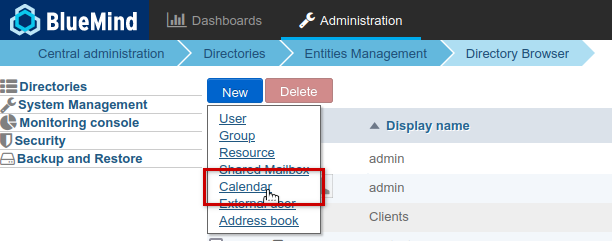
- From the Directories home page, click on "Create a calendar" or from the list of directory entries use the button New > Calendar:
- Enter a name and, if applicable, select a domain from the popup window that appears:
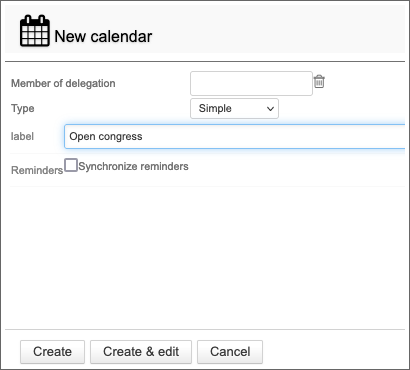
- Click on "Create" for a simple and direct creation of the calendar, or click on "Create & edit" to create the calendar and access the configuration options.
Configuration
General Options
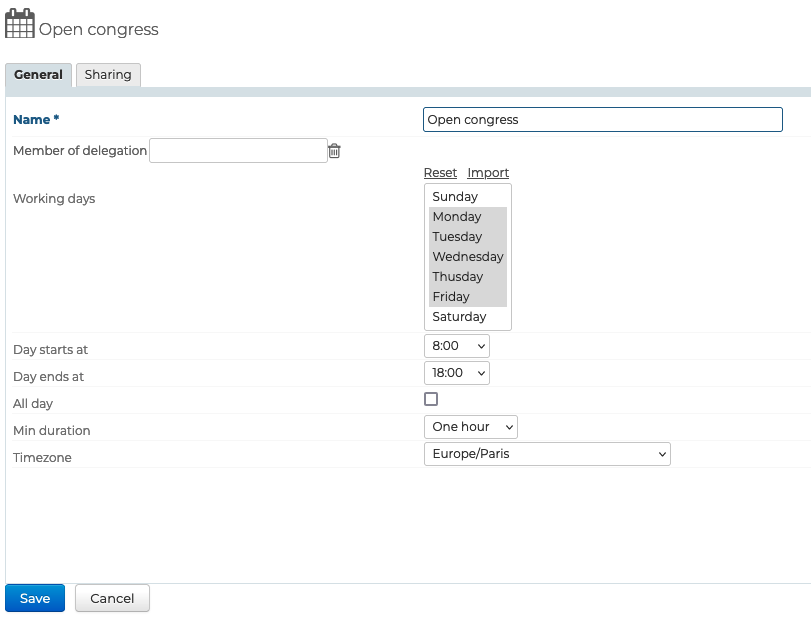
A domain calendar's general tab allows you to specify calendar characteristics: working days, day start and end time, minimum appointment duration, time zone.
Sharing
By default, newly-created calendars are not shared with any users, which means that users can neither view nor add appointments into them.
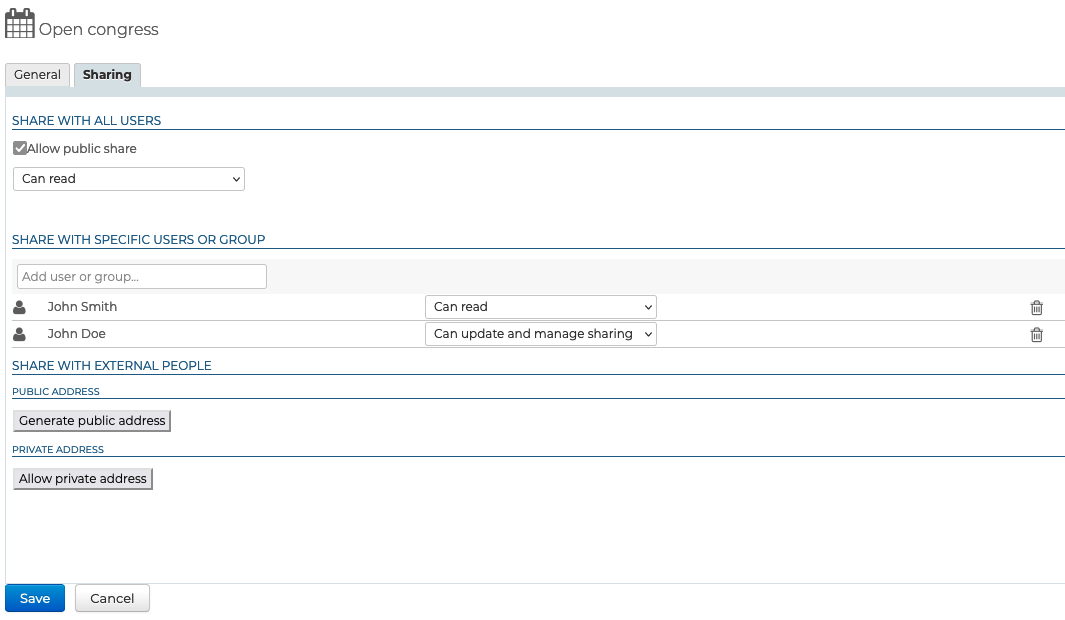
Sharing rights can be assigned to:
- all domain users for shared public calendars, e.g. for company events
- specific users, e.g. for a management calendar
- a group, e.g. for a project calendar
The following rights can be assigned:
- Can Read: can view appointments
- Can update: can set and edit appointments
- Can update and manage sharing: can, in addition to writing, administer the calendar's sharing options
Share with all users
By checking this box, the selected sharing option is enabled for all domain users.
Share with specific users or group
This section allows you to select the users or groups you want to assign rights to.
Start typing the name of the user or group in the input field and confirm with the enter key or by clicking on the name suggested by autocomplete.
For a company diary, for example, all users will be able to consult the diary, and the company secretary will have the right to set appointments, so that he can include company events, as well as compulsory vacations.
External Calendars
Domain calendars can be a synchronized external calendar. It is created and administered in the same way as a simple domain calendar.
Creating
When you create a calendar (see above):
- Select "external ICS" in the dropdown list and paste the external calendar's url in the box that opens:
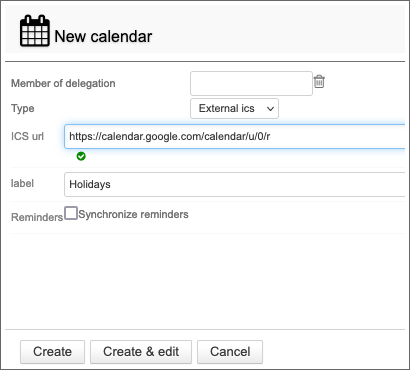
- When you leave the box (with the shift key or by clicking outside the box) BlueMind validates the url. As long as the url is considered invalid, the calendar cannot be created.
- Fill in the name if it is not automatically found or if you wish to personalize it
- Click "Create" to quickly create the calendar with default options (not shared) or "Create and edit" to access calendar options, including sharing.
Sharing
Sharing rules are the same for external and BlueMind domain calendars, with one exception: like external user calendars, domain calendars are available for viewing only: changes are not applied or saved on the original calendar.