Integrating Video Conferencing with Zoom
BlueMind can be connected to the Zoom conferencing system to enable users to easily create conferences and link them to their agenda meetings.
Installing and Configuring Zoom
Installing the Zoom packages
To make the new features available to users, install the following packages on the server and then restart BlueMind:
- Debian/Ubuntu
- RedHat/CentOS
aptitude install bm-plugin-admin-console-videoconferencing-zoom bm-plugin-core-videoconferencing-zoom
bmctl restart
yum install bm-plugin-admin-console-videoconferencing-zoom bm-plugin-core-videoconferencing-zoom
bmctl restart
Configuring the Zoom instance
Zoom configuration in BlueMind requires OpenID authentication. This requires configuration from the Zoom administration console to give BlueMind authorization to query the Zoom server for the user authentication needed to access videoconferences.
Configuration requires Zoom instance administration rights.
- The integration saved with Zoom requires the following OpenID scope:
meeting:write - The Redirect URL for OAuth and OAuth allow list parameters must match the URL
https://<external-url-bluemind>/bm-openid/auth/videoconferencing-zoom. - Retrieve the following two parameters, which will be needed for the BlueMind configuration (see below):
- Application ID
- Application Secret
Setting up OpenID Authentication
Go to the BlueMind administration console in System management > Supervised domains > choose the desired domain > OpenID tab:

Use the following values to fill in OpenID authentication data:
- OpenID Endpoint URL:
https://zoom.us/oauth/authorize - Application ID: provided by Zoom, obtained during Zoom setup
- Secret: provided by Zoom, retrieved during Zoom setup
- Token Endpoint URL:
https://zoom.us/oauth/token
Configuring the Zoom server
Enable videoconferencing
To enable videoconferencing for users in a domain, configure the invitation template for the associated resource.
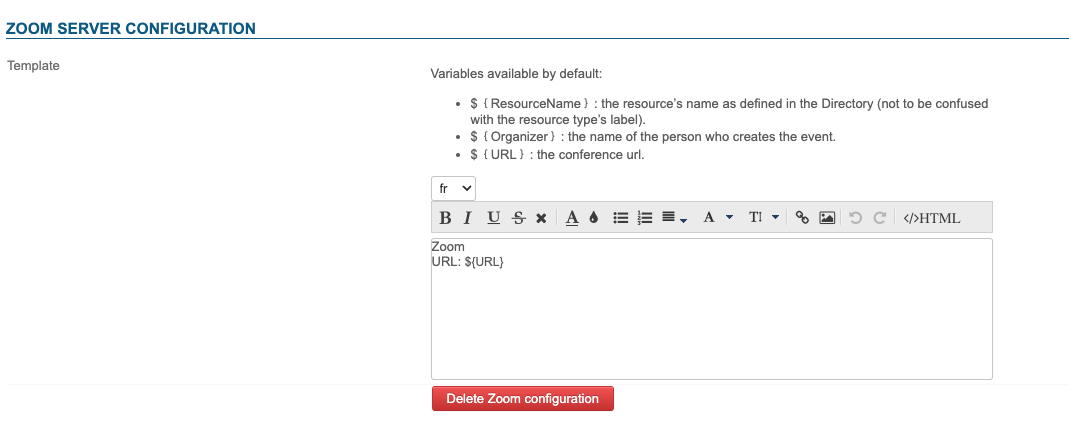
To do this, go to the administration console > System Management > Managed Domains > select the desired domain > Videoconferencing tab:
-
Fill in the invitation pattern to add a message accompanying the link to the videoconference
-
Select the desired language from the drop-down list
ℹ️ Multilingual
Language settings are saved, so you can switch between them without having to save after each change.
To remove a language, clear the content field (select the text and delete it).When creating an event, the content will be added to the invitation based on the organizer's language.
-
Fill in the content:
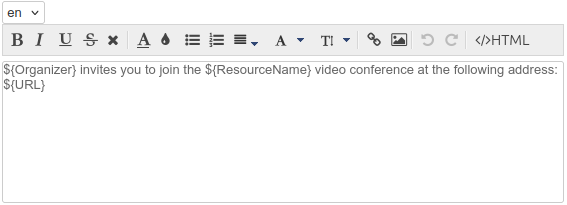
The template may contain variables, which are automatically replaced in the text by the system:${NomRessource}: the name of the resource as defined in the directory${Organisateur}: the name of the person creating the event in the Calendar${URL}: the conference access URL${siteURL}: Application-specific URL
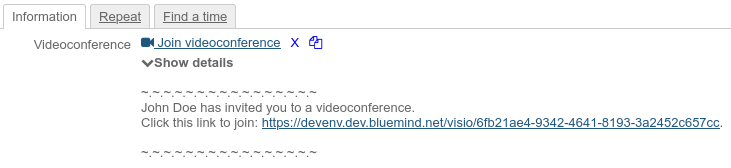
When a user adds a video conference to their event, the text defined by the template is automatically added to the event and to the invitation email sent to participants:
-
-
Click Save
⇒ A resource named "Zoom" is automatically created and added to the directory.
In order for users to be able to use it, they must be granted sharing rights for the resource.
Create static videoconferences
The configuration of Zoom allows you to create so-called "static" videoconferencing resources: their names and access URLs remain unchanged, and their booking and visibility permissions are managed independently of the main videoconferencing resource.
For static resources to work, the main videoconference must be enabled. See the previous paragraph Enable Videoconferencing.
To set up a videoconference like this:
- Click "Add a static video conference":

-
Enter the desired name and join URL for the videoconference
💡 The login URL must match the URL of an existing static video conference in Zoom.
↳ A resource with this name, linked to the Zoom videoconferencing system, is created and added to the directory:

Once created, static video conferences are managed in the same way as the main video conference.
Disconnecting the Zoom server
To disassociate a server Zoom from the domain:
- go to System management > Supervised domains > choose the desired domain > Videoconferencing tab
- click the "Delete the Zoom configuration" button
- validate the confirmation request
There's no need to click on the "Save" button at the bottom of the page, as your request is effective as soon as you've confirmed it.
⇒ The associated resource is automatically deleted and the shares are cleared; it no longer appears in the entity management interface, and users can no longer reserve it.
Accessing the videoconference
When a user uses Zoom videoconferencing for the first time, the OpenID protocol (see above) is used to authenticate the user to the Zoom server, and BlueMind will retrieve a secret key authorizing it to create videoconferences on the user's behalf.
Giving users rights
The new feature is accessed via the Zoom resource created during BlueMind configuration (see above):

This resource is managed just like any other; it is through the sharing settings that you can grant booking permissions and, consequently, generate videoconference links. Therefore, you must grant a reservation right (a "can book this resource" sharing right or higher) to the desired users or groups so that they can create video conferences for their events.
By default, la ressource n'est pas partagée, les utilisateurs ne peuvent pas lier de visioconférence.
As a resource, it can be assigned working hours or a reservation policy. However, as the link generated is unique, this will not affect the availability of the videoconference itself: the link will still be active and available outside these times.
Using the resource
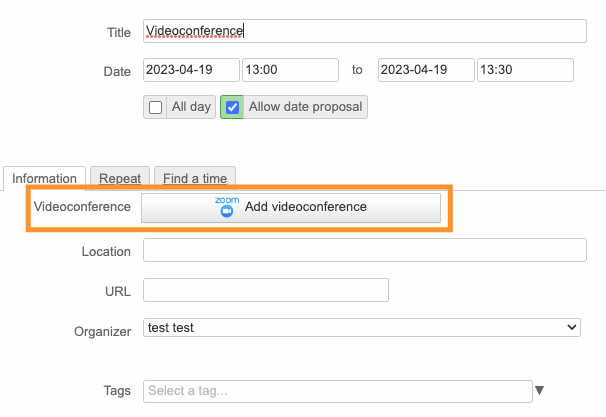
The resource must not (and cannot) be invited to an event from BlueMind by adding it as a participant: once the configuration is complete, you must use the available buttons:
- in the BlueMind navigation bar:

- In the interface for creating beneficiary events: